Nicole Johnson & Tom Horton
FOXG1 Research Foundation Stares Down The Impossible
She refused to believe doctors who predicted doom for her daughter. He walked 500 miles for his granddaughter with the same condition. Now they’re on the cusp of a potential breakthrough.
The
doctor had terrible news.
The child, they said, will likely
never walk.
Never talk.
And might not live past their
teens.
One of our guests today, Nicole
Zeitzer Johnson, lived this moment. But her response was extraordinary.
When Nicole learned that her
daughter, Josie, had a rare genetic disorder called FOXG1 Syndrome more than a
decade ago, she heard the doctors who said: "There's nothing you can do about
it."
She just refused to believe them.
Instead, Nicole dedicated her
life to finding a treatment.
She founded the FOXG1 Research
Foundation. And in the years since, she's done what most people would have
called impossible.
They founded a lab. They've completed
groundbreaking research. And their work has produced a treatment that is in a
clinical trial.
It's the sort of feat that's
usually reserved for billion-dollar pharmaceutical giants.
Nicole and her team did it
faster, cheaper, and leaner than most would have thought possible.
She wasn't alone. Tom Horton, the
former CEO of American Airlines joins her.
Tom's granddaughter, Gianna, also
has FOXG1.
He's been an advisor to Nicole
and her team ever since. And he recently walked over 500 miles to raise
awareness and money for their cause.
Tom and Nicole join us this
episode. We discuss:
- How Josie has defied the odds and today is a beautiful 14-year-old who brings joy to her family
- The two words that put Nicole on a path to developing a new treatment
- How Nicole and her team challenged conventional wisdom and created a new model for gene therapy at a fraction of the usual cost.
- Tom's 500-mile journey carrying the names and prayers of children who cannot walk themselves, and what he learned from it.
- Why their success is a blueprint for thousands of other rare diseases that have been left on the shelf.
Nicole and Tom prove that when
you stare down the impossible, sometimes it blinks.
I hope you'll enjoy our
conversation with them.
[10:15] Building the Lab: How the FOXG1 Research Foundation created a new model for gene therapy at a fraction of the usual cost.
[18:40] The 500-Mile Journey: Tom Horton discusses his walk and the "Gianna effect" that drives his fundraising.
[25:55] The Science of Hope: Why FOXG1 research holds the key to treating conditions like Autism and Alzheimer's.
[33:10] Staring Down the Impossible: Nicole's advice for anyone told that their goal is unreachable.
FRANK BLAKE: Well, first off, I just want to welcome and say what an incredible privilege it is to have Tom Horton and Nicole Johnson on the show. As you're going to hear, as we go through this episode, what they've accomplished is truly extraordinary. I will tell you, I am personally in awe of it, so welcome to the show.
TOM HORTON: Thank you.
NICOLE JOHNSON: Thank you so much.
FRANK BLAKE: So, I'm going to start right off with the question of, for listeners who have never heard of FOXG1 syndrome, how do you explain how the condition impacts a child?
NICOLE JOHNSON: Sure. Yes. I mean, most people have not heard of FOXG1 syndrome. It's an ultra-rare disease. When my daughter Josie was born, she was born in 2011. When we finally got her diagnosis in 2014, I was told she was the 92nd person in the world-
FRANK BLAKE: Wow. Wow.
NICOLE JOHNSON: ... known with FOXG1 syndrome. Today, we know of about 1,800 identified. So, it is growing, but how it affects the child and the family, wow. Well, there is a spectrum of severity of patients with FOXG1 syndrome. So, it ranges from the more severe to the less severe. On the less severe side, children appear highly autistic. FOXG1 is an autism related gene. So, they have a lot of behavioral issues, but children on the less severe side can walk. But then you go through the spectrum and children in the middle and on the more severe side have significant disabilities.
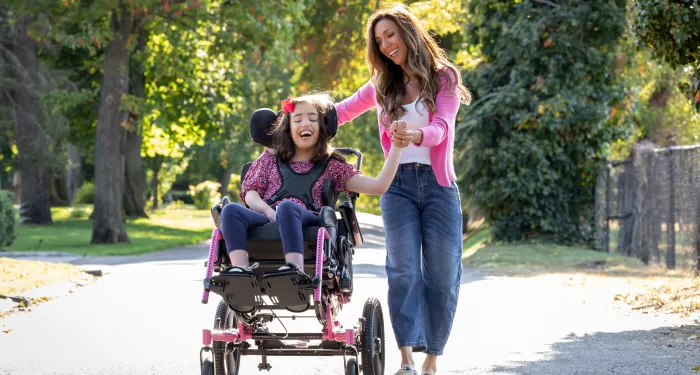
So, Josie is on the more severe end of the spectrum of FOXG1 syndrome. She is now a beautiful 14-year-old young lady, but she never met any of the developmental milestones. She doesn't walk. She doesn't talk. She can't sit up without falling over. She suffers from epilepsy, which at the moment is under control. She has a feeding tube. I just made an appointment today with a neuro-ophthalmologist for I'm seeing new things happening with her eyes.
But for all the things that Josie cannot do, she
makes up for it in her pure joy that she brings to our family and this
perspective in life that I don't know that I would've had otherwise. And that
seems to be a common thread across the FOXG1 community, that our children are
so joyful and amazing. And we do know they understand and they're there. And
she just motivates me every day to do, to do more, to give her, to somehow do
everything I can to potentially give her a little bit more of what she
deserves.
FRANK BLAKE: Tom?
TOM HORTON: So, for our family, our first grandchild, Gianna, was born with FOXG1 syndrome, and she's beautiful. So, here's a picture of her. That's Gianna.
FRANK BLAKE: Oh, how sweet.
TOM HORTON: Right?
FRANK BLAKE: Yeah. How sweet.
TOM HORTON: She is now six years old. So, when she was born, we, my son and daughter-in-law, noted that she was missing some milestones, as did her doctor. And she was about a year old when we had the genetic screen done and she was diagnosed with FOXG1 syndrome. And we said what you said at the outset, Frank, which is, "What is FOXG1 syndrome?" And we did a bit of research and learned that it is all the things that Nicole just said. And we quickly got linked up with Nicole and Nasha, her co-founder of FOXG1 Research Foundation, and learned what they were up to and got involved, which we can come back to.
But I'll just tell you, I'll echo what Nicole
said. It's all-consuming for a family and there are degrees of severity. I
would say Gianna's probably maybe in the middle. She's unable to walk. She's
nonverbal. She's highly expressive, which you could probably tell from that
photo.
FRANK BLAKE: Yeah.
TOM HORTON: Very engaging. Very socially engaging. And Nicole used the right word, just joyful. I mean, these kids are just joyful. They love music. They love to be around their family. They love to be in the water, but they have these very severe disabilities, which we think there are opportunities to dramatically improve through the gene therapy. We'll come back to that too. But anyway, and it just really affects the family in very profound ways, which it sounds like you have your own personal understanding of it.
FRANK BLAKE: Yeah. When you first learned about FOXG1 and the diagnosis, what surprised you most, either about how little or how much was understood about it, and to either of you?
NICOLE JOHNSON: Yeah, I could start with this. So, my experience was in that geneticist's office in 2014, when at that time he said Josie has congenital variant of Rett syndrome, and it's the FOXG1 gene. And the prognosis he gave me was very dismal. I've actually spoken to him in recent years, where he must have heard me talk about this on a podcast, where he said, "I have to apologize for what he said in the office that day," because they didn't really know.
And so, I think they might've looked up Rett syndrome, or might have done, I don't know, I said a Google search and said that the lifespan was teens at best. It was really the worst diagnosis, I think, a parent can get in that doctor's office. And I left there with just this feeling of, "Well, how do they know? There's so few cases of it." And I dig in and started researching it. And what was so surprising, to your question, is how little was known.
And since then, how much is known now is really
quite a story, but there was so little known and there was nothing... Most
people we spoke to, it was, "There was nothing you could do about it.
Josie will never do these things. She will never walk, she will never talk, and
there's just nothing you could do about it. So, go home and be the best parent
you can, and do lots of therapies if you want to." And I just had this
feeling that just wouldn't go away, that maybe there's nothing now, but maybe
there could be. So, when there isn't a path, maybe you just have to create that
path.
TOM HORTON: And Frank, here's something surprising that I learned throughout this and getting to know some of these families and being involved. The cognitive abilities of these kids can be quite high. And there is a boy, now a young man, who is at Columbia University with FOXG1 syndrome.
FRANK BLAKE: Wow.
TOM HORTON: Diagnosed late. He has many of the characteristics Nicole just described, but his father constructed a communication mechanism for him, which is a whole story unto itself. So you know these kids have a lot to say and there's a lot going on in their minds. It almost makes it that much more wrenching to think that they're unable to communicate what they think and how they feel.
FRANK BLAKE: The amazing story here that we'll get into in some detail is... And for our listeners to understand that both of you have led the most significant parent-led research effort, taking a genetic issue through from just research to poised for clinical trials. And so, my first question on that, because I know how difficult and unique that is, is how intentionally did you embark on that, or was this small step, small step, and you found your way to this over time? What's a little bit the story of the pathway to what you've done?
FRANK BLAKE: So, what age is your child, Josie, at this point?
NICOLE JOHNSON: Oh gosh. So, this was when we first had our... We launched the foundation in 2017. We had this conversation. It was probably 2015 when we first met, and Josie was born in 2011. Amara is nine today, so she's a few years younger than Josie. And we just said, "Let's start." There was nothing out there. There was no concerted research strategy out there. So, we said, "Let's start." And we really put our heads down and put on our entrepreneurial caps. We had both been part of founding teams. We were entrepreneurs already. I had a history. We thought of everything we did in life and how we learned something from it to lead us up to what we will need.
And so I spent 10 years as a news producer at CNN in the '90s, a long time, but I learned how to be resourceful and I learned how to get to the heart of the story. Very fair and balanced news back then. And then I became an entrepreneur in the music business at the time, and we just said, "Let's think of this like a startup, and where do we begin?" And we started speaking to biotech CEOs and asking them, "If you were to ever invest in a rare disease like FOXG1 syndrome, what would you need from us?"
And they all told us what they need. "We need the assets. We need the mouse models. We need the IPSC lines. We need models, so that if we ever do develop a treatment, we have the models to test them on. We need patient data. You need to start a patient registry right away." I think we were starting it as we heard this. "You need a natural history study." And I could talk to you for another hour, of how we then reinvented the way natural history studies are done, because we realized that we need better, richer data, faster. So we found out a way to make natural history studies digital models.
So they told us everything that they would need to even look at us. And we did the workback approach, and we created everything to really build the foundation. And something that was very important to us was to realize that there are different mutation categories of FOXG1 syndrome. And we're not just here to find a cure for our own children. There are children born with different mutation types. So we made sure that all of our models matched the different mutation types, and that all of the data laid on top of it, so that we can really be here for the worldwide community of FOXG1 syndrome. And we really just kept this startup mentality and looked at all the verticals that a business has, and built it, like you said, step by step.
Our goal was always we want to have therapeutic treatments for children. We knew that there was this rise in genetic therapies happening. We're living in this scientific renaissance right now and the science is there. And so we kept our heads down and did step by step, knowing that's the goal. And then, I think a huge part of it is really the people that joined us along the way. It's pretty miraculous that we just kept our heads down doing the work, but all the people that were necessary to help advance this were right in front of us, came to us, including the Lees, who are the world's leading scientists on FOXG1 syndrome, who also happened to be FOXG1 parents. So, this is really a parent-led drug development story.
And then Tom joining us, and having this great experience in working with this American business leader, who has joined us, and really this mentorship and helping us just change our fundraising strategy, helping us launch our campaign. So, I always say that while getting Josie's diagnosis was not a fortunate event, everything since that day has been a series of fortunate events, and I'm so grateful.
TOM HORTON: Well, Frank, I would say I came in, I don't know anything about this. I don't really know anything about raising money. I'm not a scientist. I didn't really... I just thought to myself, "What can our family bring to this to help?" And we were blown away by Nasha and Nicole, and what they had accomplished at that point. You've just heard some of it, and I'm sure you can appreciate that. We got to know them in probably early 2021. So, it was, I think, first quarter of '21, we got together. This is during COVID. It's over a Zoom call, and we heard some of the pitch you just heard and the groundwork that had been done, and we were just so struck by it.
Obviously, a very profound thing in our own family, but we appreciated how, with all the resources our family has, and just how hard this was on these hundreds of other families around the world. And there are many stories, which we could tell you about. But this became our principal philanthropic mission. And obviously, we had personal vested interests, but when I heard all the things that had been done, basically creating a startup, yeah, it was daunting. And as a business person, I appreciated how daunting it was, but yet their enthusiasm and their competence was infectious. So, that was how it started.
And we started by... I just thought to myself, "What can I do?" Well, I'm not a scientist, I'm not a doctor, I'm not a parent, I'm not a caregiver, but I can help raise awareness of a platform, I can raise money, and I can pray for these kids, and pray for the parents and the families. And I thought those are three things I can do, our family can do, and that's what we're going to do.
So it started with... After meeting Nasha and Nicole, and spending a little bit of time with them, learning about the Lee Lab at University at Buffalo, getting a little bit more diligence under our belt, we decided to make a million-dollar donation to help jumpstart the next chapter. And we said we'd match the first million dollars in donations. I sent a letter out to 70 or 80 of my close friends and business colleagues, and very quickly, we had a million dollars matched, and that's how we got involved.
And I'll tell you one last little anecdote from that. I sent these letters out and we got some big donations. It was just so heart-rending. But I got a response from one guy, a crusty Wall Street guy, who wrote a big check, and I had sent a letter out with a picture of Gianna. And he responded to me with one sentence, and he said, "What a beautiful gift."
FRANK BLAKE: Wow.
TOM HORTON: And I've said that to Nicole a couple of times. I was so struck by that, and it helped frame this for us and our family in a way that I think we knew deep down. But yeah, these children are a gift and they're a gift with attendant challenges. But they are a gift and we need to see them that way and do everything we can to help make their lives better. So, anyway, that's how we got involved.
FRANK BLAKE: Yeah. And as this was developing over the last several years, you're working within a very complex scientific medical community. Are you met more by indifference or dismissal, or, I mean, how open were people to this, just because rare diseases are such a difficult problem to solve, period, full stop, across the board?
NICOLE JOHNSON: Yeah, constant dismissal. Constant.
FRANK BLAKE: Yeah, constant dismissal.
NICOLE JOHNSON: Constant dismissal and constant, "Oh gosh, I'm sorry, you have a big challenge ahead of you." Sometimes I would get these great meetings with people that want advice, and I'm so grateful for any minute I have with anyone. And it was the advice, actually, because they would look and say... Because let's face it, a rare disease is not a viable investment opportunity for pharma. It just isn't.
We started to see some biotechs picking up rare disease programs and we got so excited. Ours was even picked up, but then they were dropped. So, there's actually an article in Bloomberg magazine featuring me and Josie that says, When a Miracle Cure Is Left on the Shelf. And we're the answer to that. What are parents to do? So, everyone's saying, "This is like David versus Goliath here." So, we just thought there's got to be a way.
I've been saying this line recently, that when pharma says no, but science says yes, we are parents showing how, because the science is there and we're seeing so much happening with gene therapy right now, and there is a way to drive drug development to the patients with the greatest unmet need.
And that's what rare diseases are, and that's what we're showing. We are bringing a gene therapy into patient clinical trials this year. And what we're doing that's different is we are the sponsors of this clinical trial.
FRANK BLAKE: And this is really the first?
FRANK BLAKE: Oh, FOX Research Foundation.
TOM HORTON: Yeah.
But what really is so great about it, because
for all the people... For all those times I said, "Who's going to care
about FOXG1 syndrome?" I realized that the work we're doing is so much
bigger than it. So, not only once we realized that it's an autism-related gene,
that was a big aha moment, but that we're paving the way for other rare disease
parents to drive treatments to their children.
So, we're creating this new model to cut down the cost and the time and giving a way to sponsor it yourself. So, we're able to sponsor it ourselves because we have found this new model to cut down the cost and time, where typical drug development can cost $180 million, take 30 years. We have found a way to do it in 12 years for around $22 million, not 180 million. So, there is a way. We're showing there's a way. This is an unfolding story, and we will begin our clinical trials in 2026.
FRANK BLAKE: Amazing. Exciting.
NICOLE JOHNSON: Yeah.
FRANK BLAKE: And Tom, did you have the same experience of dismissal from folks, saying, "Eh, compelling, but just this isn't going to happen"?
TOM HORTON: Yeah, sort of vicariously through the foundation and following our conversations with pharma and others. But I would say I had a 180-degree reception from generous donors, and I don't know how to ask people for money. I'm one of those guys who, if somebody would come to me and say, "We need you to help raise funds," I'd say, "How big a check do you need?" because I'm not going to do that, right? It doesn't come natural to me.
But when it is your family and it's so personal, you can change. So, I have become a little bit shameless in this regard. Since that time of that first round of fundraising, we did another friends and family round, and then we took to approaching some high-net-worth friends and colleagues. And without getting too mercenary about it, I'll just tell you that we had a handful of people write million-dollar checks.
FRANK BLAKE: Wow. Wow.
TOM HORTON: Unbelievable. And the reason I say all of that is that it's such a testament to the incredible generosity that exists in our country. People here are able to create tremendous wealth. Of course, that's a hallmark of our system, but when you have a need like this and you put it in front of them, and you explain it to them, and, yeah, maybe there's a personal relationship, which is helpful and meaningful, it's extraordinary how people will rally to it.
FRANK BLAKE: That's terrific.
TOM HORTON: And that's been... So, yes, on the commercial side or the pharma side, we've had some doors slammed on our faces. On the other hand, the story is so compelling, and what Nasha and Nicole and Ryan, and the team have done, it really speaks for itself. And people are compelled by this, I think, this mission of a parent-led drug development model for these sorts of situations, a rare disease. And the fact that it is a model that, I think, can be replicated, I think it resonates with a lot of people.
FRANK BLAKE: What do you think the scientific medical community has learned from interacting with a parent-led effort like this?
NICOLE JOHNSON: One remarkable thing that happened along the way was, we launched the FOXG1 Research Center at the University at Buffalo with the Lee Lab. And that was a very unique experience, to have an academic institution get behind a rare disease and create a lab just for one rare disease, where they had 20 different scientists working on different aspects of FOXG1.
So we're just seeing this change happen within this space where... And it's also a very exciting time with gene therapy and different modalities. So you're hearing about gene editing and some just remarkable stories. We hope that, in the industry and in the community, people will pay more attention to realize that it is the patient advocacy groups that are moving the needle for rare disease drug development. So we're hoping that this story-
FRANK BLAKE: What were the numbers again? It was over $100 million and you've gotten it down to 22?
NICOLE JOHNSON: Yeah. So traditionally-
FRANK BLAKE: Yeah, amazing.
NICOLE JOHNSON: ... it's $180 million and 30 years. So, our model is, we are bringing this FOXG1 gene therapy through clinical trials for $22 million, as long as everything goes as planned. And we've done it since beginning, 12 years, so really shortened that timeline.
FRANK BLAKE: What were some of the inflection points in this effort, something, the big challenge moments that you had to get over to get to this point of being on the verge of clinical trials?
NICOLE JOHNSON: So I often say that this foundation is a three-legged stool. So, one is the science, one is the patient data, and then the other is the community. And without one of those legs, the stool falls over. So, everything is equally as important. So, there were a lot of inflection points in the science. There was the inflection point of realizing that if we really wanted to get enough patient data to get through a clinical trial, we were going to have to reinvent the way these studies were done. Because we saw that the way natural history studies were done was, I would have to bring Josie into a clinical center and they would evaluate her, and I'd bring her in maybe twice a year, and that's the data on Josie. And when we looked at the timeline of natural history study data programs, they were, I think, 12 years.
FRANK BLAKE: I'm just imagining a lot of people saying, "I understand your passion on this. I understand your passion as a parent or a grandparent, but you just don't understand blank, and take a step back. You don't know." Was that a constant?
NICOLE JOHNSON: So that was constant. And I think our mentality was we couldn't listen to it. We just had to say, "Well, we do understand. We understand what isn't understood, and we're going to find a way how." So we just really kept our heads down and put blinders on, because if we didn't, we would be... We didn't want to believe that it couldn't be done. So we believed that it could, and that's our mindset, is really just believe that it could be done and the right people will join you.
So the ones who didn't, we tried to see how we could show them that it can. And that was really... We always turned it into a positive. We always turned it, and we understand where they're coming from, so we're going to show them to understand where we're coming from. And from that first conversation with Nasha in 2015, there's got to be a way, and we're showing that there is. So for all the naysayers, for anyone whoever says, "It can't be done," we just truly believe that it can.
And of course, we'll celebrate when the children receive the gene therapy. We're not celebrating yet, but we know we're on the road to really improving parents', families', and children's lives. And I like to think of the children who aren't even born yet, and the parents who are going to go in that geneticist's office and find out your child has FOXG1 syndrome, and then, in the next sentence, say, "But there's a treatment." So, really, I think of that day that I was in the geneticist's office in 2014, and that feeling that, "How does he know?" And I don't want another parent to ever have this experience again.
FRANK BLAKE: So, Tom, as you're engaged in this and interacting with it, do you see an inflection point? Do you see a point where you go, "This has been a great emotional commitment, but actually, now I see it's moving to true broad significance"?
TOM HORTON: Yeah, there are a couple of things. The answer is yes. We do have a very accomplished scientific advisory board, so we probably haven't given enough credit to the scientists that are in and around this thing, who've been helping us in an advisory capacity. Then we have this lab at the University at Buffalo, with some 20 people actively working to develop the gene therapy compound. We hired-
FRANK BLAKE: Are either of you in Buffalo? Why Buffalo?
NICOLE JOHNSON: So, that's where the Lees were recruited to. They were in Ohio, and then University at Buffalo brought them over. Yeah. No, I'm in New York, but not that north.
FRANK BLAKE: Got it.
TOM HORTON: But that just happened to be where they were, and that's the couple who are FOXG1 parents, who are leading this research lab, which is extraordinary. And it's been supported by the university, which is part of the State University of New York. So, it's been really incredible. So, that, I think, a big inflection point started early on, but really got ahead of steam.
And then we hired a drug developer, who is one of the most accomplished drug developers you could find anywhere, who's got just an incredible resume, who is leading our drug development effort, which is a whole science unto itself, as I'm sure you can appreciate, Frank. And so, he's navigating the waters with the FDA and the whole process of getting it manufacturers and everything, bring it to market. So all those things have come together. So, a lot of science and a lot of pick-and-shovel work around getting it together.
I do think, as Nicole said, this is parent-led
and privately funded, so raising funding sufficient to get up ahead of steam
here and give us credibility was important. And to date, we've raised $14.5 million.
We've got a ways to go, but we've got a line of sight on some of the next
tranches of fundraising. So, getting the funding in place has given us, I
think, an important... It's been a bit of a turbocharger. So, it's been the jet
fuel on the fire here. Nicole brought the logs and got the fire started, and
the whole team did their thing, but it really needed a financial boost. And I
think we're firmly on track with that. So, I think those things are...
And I would say one other thing. We've gotten... The story is important, right? That's what helps you build momentum and build awareness and fundraise. And we've had a lot of help. So, early on, in addition to financial support, we've had some pretty heavy hitters come in with pro bono help. So, Declan Kelly, who founded Teneo, has leaned in both as a very large personal donor, but he brought his firm, Teneo, to the party here to help us build the story and tell the story, and work with Nicole, who's a pro in this in her own right. And they've been very helpful. And he's gone on to found another firm. He's continued to be helpful at Consello. Teneo continues to help us out.
Paul Weiss has leaned in, as we've got some of
the very best IP lawyers helping us manage the IP process here. So, it's just
been a... You think about the heroes in this, and it's all the people who have
donated their time and their money, and their energy. And then, of course, the
ultimate heroes are these parents, the parents who are taking care of these
kids every day. So, it's just been a virtuous cycle, maybe is the best way to
describe it. Nicole described it. We all got that news early on, and it was
disappointing and hard, and yet, ever since, it seems like things just keep
getting better and we keep making progress, and that's all you can do.
FRANK BLAKE: So, Tom, I want to ask you about your 500-mile walk. Maybe just describe it briefly to our listeners, and what message were you trying to send to donors and researchers, and to families?
TOM HORTON: Yeah. So, as you can imagine, our little philanthropy group has been hatching lots of ideas about how we raise another few million dollars. And so, one idea I tossed out there was... I've been thinking about walking the Camino for some time. So, the Camino de Santiago is a primarily Catholic pilgrimage, but it's a pilgrimage and it's a walk that now people of all faiths and no faith at all do. It is to the Cathedral de Santiago de Compostela, which is in Santiago, Spain. It is the place where, tradition has it, the remains of St. James the Apostle, St. James the Great, are laid to rest.
And so, it has been a pilgrimage for over 800
years. I mean, it's a long tradition. Various routes across Europe into that
cathedral. But maybe the most famous one, the most common one, is called the
French Way, The Way of St. James. It starts in St. John, in the French
Pyrenees, all the way across Spain to the western edge of Spain, where
Santiago. It's a 500-mile trek. And so, I floated this idea, and everybody was
quick to volunteer me to do it.
FRANK BLAKE: Yeah, exactly. Great idea, Tom. You do it.
NICOLE JOHNSON: Yeah.
TOM HORTON: We're right behind you. So, we got it all arranged, and I set up to do it. And the idea was quite simply that... I did this back in August, early September, that we would use it to raise awareness, we would use it to raise more money, and it would be a mission of prayer. And so, I did about 15 to 20 miles a day. I did it with my brother-in-law, and we would stop in these little towns along the way, overnight. Typically, there would be a pilgrims' mass. We would go to mass.
And I brought along with me a list of all the kids on our registry, several hundred kids. Nicole helped me organize. And so, each day, I would carry the list of kids with me, and each evening, pray for each of them, a small group of them each day. And so, we wanted it to be very much... It was awareness and it was fundraising, but fundamentally, it was prayer. And I believe in the power of prayer. And I think a lot of the things that Nicole has described would be hard to describe without some form of divine intervention. I mean, just think about the odds we were up against here and where we are today. So, yeah. So we did that. We raised a million and a half dollars.
And I'll tell you, Frank, on Christmas Eve, I
got a note from Nicole that somebody had made an anonymous $1 million donation.
And if that's not divinely inspired, I don't know what is. So, it was
incredible. And again, just such gratitude to people who have weighed in, large
and small, to help us bring it where it is today.
FRANK BLAKE: Was there a change in your thought process at mile 400 versus mile one, or pretty steady across the 500-mile trek?
TOM HORTON: Well, I will tell you, I turned off my devices, so I decided I was going to make this very much a... I was going to try to put the walls up as best you can when you've still got some stuff going on. So, my assistant could get hold of me, but it was... I didn't look at my iPad. I didn't look at any news, and I really tried to set my mind to the mission at hand, and that was something I've never done before.
And in my whole career, I've never really been
able to take a block of time and just block everything out and focus on one
thing, and I focused on this. It was deeply meaningful. I will tell you, that's
a lot of walking, and by mile 400, I was about ready to get it done. It's a lot
of time on your feet. But there were some moments along the way that were just
so extraordinary and so indescribable that it was a gift. It was very much a
gift, and I'm forever grateful for it.
FRANK BLAKE: What does success look like for you and the foundation?
NICOLE JOHNSON: So, success looks like a world where the parent in that geneticist's office is told, "Your child has FOXG1 syndrome, but there is a treatment." So, success looks like an easier life for FOXG1 families. That's the goal, and what a treatment brings for so many of us. Sure, we hope it's a cure, but we do understand. We manage our expectations of what treatments mean.
And for us, if there's something that could just
make life a little easier for Josie, if maybe she can sit up a little longer on
her own, or if there's just giving something back to children that they don't
have because of this disease is success, I would have to say that. And then
everything else that comes along with it, which I know there's more to it for the
greater rare disease worlds, and so much more that could follow through this
work.
TOM HORTON: Yeah, well said, Nicole, as always. I think, Frank, there'll probably be maybe a different answer for an infant than there is for a six-year-old or a 15-year-old.
But if you were to ask me the question, I would
say we want to see these kids be able to talk, walk, have motor skills that
enable them to function and live a full life. And so, that's very simply the
way I... When I dream about it, that's what I dream of.
FRANK BLAKE: What gives you the most hope right now?
NICOLE JOHNSON: The most hope right now is what we're seeing in science, and that it's just exponentially more and more success stories in genetic science. So, science gives me the most hope.
I just watched a video of the first patient who got a gene therapy from another rare disease. It was the first patient, and it was 23 months later, and they just put out a video from Grace Sciences. And watching this video and seeing the improvement in this boy, and watching his mom tell the story, and I called my husband into the room. I'm like, "Watch this." And this boy is... And you see before and you see after, and it's miraculous.
And these stories, like spinal muscular atrophy,
children are going on to live full, healthy lives. If you told me this 20 years
ago, I would say that's science fiction, and it's not. So science gives me the
most hope, and our team gives me the most hope. It really does. Yeah. How about
you?
FRANK BLAKE: Tom.
TOM HORTON: Same. I think we're living in an extraordinary time, where these things that sound like science fiction are becoming a reality. We have one in hand and it's going to be in clinical trials this year. So, I'm very hopeful. This may not be the last therapy ever developed for FOXG1, certainly won't be.
NICOLE JOHNSON: It won't be.
TOM HORTON: I think it is a momentous step forward, but both for FOXG1, and for rare diseases worldwide. And I think that's just an exciting and amazing thing. And it never would've happened without the vision of two moms who just were not going to be told no.
FRANK BLAKE: And what keeps you up at night?
NICOLE JOHNSON: That's a great question. The remaining eight million we've raised.
TOM HORTON: Yeah.
NICOLE JOHNSON: I've taken on this role of I feel responsible for the worldwide community. I'm like FOXG1 mom of the worldwide community. And I see a lot. I talk to a lot of parents. And to be honest, we lost three children in the past three weeks. That's a lot in a short amount of time. So, what keeps me up is when our community is rocked by a loss. So, just getting there. I just want to get there. I just want to do everything we can.
So, I do try to sleep, Frank. I do my best because I know I need my sleep, but there's just so much to think about. And I'm really thinking of every family, and just really want... Like Tom said, this is the first treatment for FOXG1. We want to be here. We want the FOXG1 Research Foundation to go on and on, to make sure that as science improves, we improve with it.
And just really, it's the suffering of the
children that motivates me. It's the suffering and the pure joy of the children
that motivate me. And so, it's a lot on our shoulders, but I'm sleeping a whole
lot better in the past year, really, since Tom joined us. Thanks, Tom. And just
really seeing everything happening, it's helping.
TOM HORTON: You do think a lot about the families.
NICOLE JOHNSON: Yeah.
TOM HORTON: Both of our families have resources and we're able to help our kids, with Gianna, and night nurses and this sort of thing, but sleeping is a challenge for these kids. [inaudible 00:51:16] brought up sleep. It is a challenge. And so, in addition to the challenges of caring for the kids during the day, sleep is often interrupted and that makes it very challenging for families. And we're trying to hold down jobs and carry on with life and maybe have other kids, and all the demands of life that we all have. So, I think about them.
And during... Nicole has brought this to life on
a number of occasions for me, ways that I don't see in my own family. Early
days of the Russian invasion of Ukraine, there was a FOXG1 family that became
war refugees, and Nicole and the foundation jumped in to help out. And I just
thought to myself, "I just couldn't even fathom what that would be like,
being on the move, on the run, trying to feed your child with a G-tube." I
just couldn't even imagine that. And yet, you think, "Well, there are kids
all over the world." I mean, people in the United States have a different
reality than maybe kids in Africa do, or parts of Asia or India or wherever.
It's almost unfathomable.
FRANK BLAKE: So, again, for our listeners, what you all have accomplished to get this to this point of clinical trials is truly exceptional and extraordinary. And this is a podcast that celebrates, Crazy Good Turns, people who do amazing things for others. You both and your colleagues are doing that for FOXG1 and other families. But I always ask our guests closing questions, so I'll ask each of you. Who has done a crazy good turn for you? So, I'll start with you, Nicole. Who's done a crazy good turn for you?
NICOLE JOHNSON: I feel everybody who's joined. I mean, I'm so moved by every person who has some touchpoint to this mission of mine and of ours, of all of ours. And I have Josie's fundraising team on the website. We all have our own personal teams. And when I see these names of people in my life, who whether they donate $36 or $500 or $10, and it's someone from high school or someone I worked with in my 20s, or someone, I can never show my gratitude for the people who take time out of their day to join me.
Even if it's someone who sends me a message,
say, "I see what you're doing, and I just want to say you're
inspiring." Just saying it is a crazy good turn. It changes my day,
because I could just have my head down and not see it. And then every single
person who joins is really part of this. And it really is what keeps me going,
is just this support. That's a crazy good turn every day, so thank you to
everybody.
FRANK BLAKE: Tom. [inaudible 00:54:59] group who gets a shout-out.
TOM HORTON: Yeah, I'm going to just make it a small group. And since we're talking about this subject, this is near and dear to our hearts. There have been a handful of people who have just gone, and I'll leave them anonymous, although I'll throw one name out to you.
FRANK BLAKE: No, don't leave them anonymous. Give them a shout-out.
TOM HORTON: Okay. So one of my colleagues, a guy who founded the firm that I've been working for for the past few years, a guy [inaudible 00:55:33]. You may know him, and he's this extraordinary guy, and he knows Zach. He knows the story of Gianna. And I was in his office one day, and this was early, when we're trying to raise a lot of money. And I told him, I said, "My old boy, it'd be really great if you could help us out here." And he just looks at me, and he says, "What do you need?" And I guess I should have been better prepared. So I said, "A million bucks," and he said, "Done."
FRANK BLAKE: Wow.
TOM HORTON: He said, "Done." And I will tell you, I've had a couple of similar experiences. That one was very striking to me, and he's a wonderful person, a great humanitarian, a great philanthropist, who is very quiet about it. He'd be mortified if he heard that I used his name.
Another is somebody you know, Frank, and that's
Gerard Arpey. You know Gerard well from Home Depot board, and he preceded me at
American. He's a close friend, and he has joined this effort in a big way. He's
on our philanthropy [inaudible 00:56:44]. He's written checks. But more
importantly, I would say, about Gerard, he's taught me a lot about just helping
people. Because I've never met anybody in my life who, as much as he does, just
looks for somebody in need and finds a way to help him. It's just an
extraordinary thing. And I could give you a million examples. I won't. We don't
have time. But he's just that kind of person. And I would say the way he lives
certainly inspired me in this effort.
FRANK BLAKE: So, where should our listeners go to find out more information and hopefully join the group that Nicole referenced to help out with this effort? Where should they go for information and understanding and being able to get involved if they so choose?
NICOLE JOHNSON: Thank you for asking. So, our website is foxg1research.org, and that's F-O-X, like the animal, the letter G, the number one, research.org. And everything is there, and anyone could reach out to us. If anyone's interested in making a gift, it's [email protected]. And I would be happy to present to anyone anytime, meet anyone anytime, who would be interested in a crazy good turn for our children.
FRANK BLAKE: Perfect. Well, again, I can't thank you both enough for being on the podcast, truly. I mean, just an exceptional thing that you've accomplished and are still in the process of accomplishing. And the interesting thing is, I mean, we can't even scratch the scientific element of what you've done, but this potentially has implications not only for FOXG1, but for a host of other diseases that are rare and structurally very difficult for the medical community to reach now, that will be able to potentially be reached with the work that you've really led the path on. So, amazing crazy good turn.
NICOLE JOHNSON: Thank you. And I just want to say, Frank, I have learned so much through your website, through your podcast and your blog as well, learning from other people who are doing remarkable things to make the world a better place. And it inspires me in what I do every day. So, thank you for what you do to shine a light on so many organizations that they're in it for the good, and it's a beautiful podcast.
FRANK BLAKE: What I tell people... Thank you for that. I tell all our listeners that listening to this podcast is its own crazy good turn, because what the two of you and those around you have done, I mean, just more people ought to be talking about that, because it's just so cool. I mean, it is just such both a labor of love, but also just a great way of giving back to your fellow humanity. It's amazing. So, thank you. Very much appreciate it.
TOM HORTON: Thank you.
NICOLE JOHNSON: Thank you.
From Frank Blake
My Sincere Thanks
Your support has helped take our little idea to celebrate generosity and good deeds, and turn it into one of the most listened-to podcasts available.
Thank you for being part of a community that celebrates people who do good things for others.
Your giving of your time to listen to these interviews, and acknowledging those good deeds, is a crazy good turn of its own.
Please help us continue to grow by subscribing on your preferred podcast platform.
And please, help us spread the word by sharing our show and website with friends.