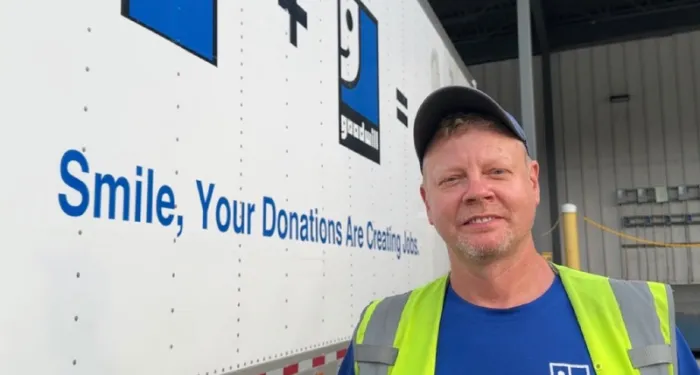
Steve Preston and Michael West
Goodwill CEO Steve Preston: Giving Goods – and People – a Second Chance
Steve Preston and Michael West join Frank Blake to discuss how Goodwill provides jobs and education to the "difficult to hire" across the country.
You might get a very specific image in your head when you hear the
word "Goodwill."
Maybe you think of their shopping centers, since 85% of Americans
live within 10 miles of a Goodwill.
Maybe it's where you donate things you finally cleared out of the
closet. Or maybe it's where you "treasure hunt" for great deals.
All of that is true. But it's just the beginning.
As you'll hear in today's conversation, the real work
of Goodwill isn't just about moving merchandise. It's about moving people
upward.
To explain, we'll introduce you to Steve Preston.
Steve has one of the most decorated resumes you'll ever see. He's
been a C-level officer at several major corporations. He also served in the
Cabinet as the Secretary of Housing and Urban Development.
But years ago, Steve wrote a personal mission statement for
himself. He wanted to help people deemed "difficult to hire" to find
a path forward.
That mission led him to become CEO of Goodwill -- and to meet our
other guest, Michael West.
Seven years ago, Michael was in a tough spot. He's a veteran who
struggled with addiction and spent time in prison. He was clean, but he
couldn't find a job. He started doing community service at a Goodwill store in
Kingsport, Tennessee — and it changed his life.
Today, Michael has a career and a wife. And he's even stood on
Capitol Hill to tell Congress what happens when you give someone a second
chance.
In this episode, you'll hear:
- The surprising history of
Goodwill, which started 125 years ago when a missionary set his sights on
India but found his true calling in the poorest neighborhoods of Boston.
- The scale of Goodwill's work
today—including 50 adult high schools across the country
- The opportunity that Goodwill
stores provided to Michael when no one else would…and the special person
he met while working there
- What employers need to do to
unlock a massive untapped labor pool just waiting for someone to believe
in them
The next time you drive past a Goodwill store or donation center
in your neighborhood, I think you'll look at the organization a little
differently. And for the better.
Please enjoy our conversation with Steve Preston and Michael West.
- [01:38] The Personal Mission: Steve Preston on transitioning from HUD Secretary to Goodwill CEO.
- [06:02] A Missionary in Boston: The 125-year history of Edgar Helms and the birth of Goodwill.
- [12:22] From Processor to Driver: Michael West shares his path from community service to a career in trucking.
- [16:55] A Goodwill Wedding: The community and family culture within the organization.
- [21:33] The Untapped Labor Pool: Why employers should look "beyond the label" of past incarceration.
- [26:52] The Future of Work: How AI and tech-skills training are reaching low-wage workers.
- [31:33] The "Internet Trash" Problem: Steve addresses the common false narratives about the organization.
FRANK BLAKE: So Steve, Michael, thank you for
joining Crazy Good Turns.
It's great to have you on as guests.
And I'd like to start,
Steve, with a question for you because I think Goodwill Industries is
interesting because it is such a well-known name, and yet underneath that I
don't think people actually know all that Goodwill does.
So maybe we just start there.
Give us an overview of what Goodwill does and maybe what people don't know
about it.
STEVE PRESTON: Well, Goodwill is the largest
nonprofit workforce development organization on the continent. We provide-
FRANK BLAKE: Workforce development. Right there.
You're away from what most people probably think about it.
STEVE PRESTON: That's right.
Well, we're glad people know the stores because they donate and shop and those
stores are an engine for opportunity.
We hire many people that have various challenges into the stores, but the
stores also are an important part of the funding for 650 job training centers
across the country where we provide placement services, wrap-around supports,
very specific skills training as well.
And we provide intensive job support services to over 200,000 people a year and
a whole variety of services to over 2 million people a year.
And we also have 50 adult high schools across the country where adults can get
a high school diploma as well as a relevant technical credential to help them
as they enter the workforce.
FRANK BLAKE: That's fascinating.
I would bet that if you gave a multiple choice to most people, they would not
think that Goodwill actually had high schools for adults. That's quite amazing.
STEVE PRESTON: They're incredible.
We actually have seven high schools inside of prisons in the state of Texas,
and those are just really remarkable places where people are just able to
re-envision their lives and when they leave incarceration, find just a
fundamentally different path to opportunity with the tools they get.
FRANK BLAKE: With that is a bunch of new items
for our listeners, I suspect.
Maybe Steve, you could give some of the background of Goodwill, start and how
did its mission develop.
STEVE PRESTON: Yeah, it's really a cool story.
So we were founded almost 125 years ago by a Methodist minister who had a dream
of becoming a missionary in India.
And the Methodist Church says, "We're not sending you to India, we're
sending you to the poorest part of Boston."
And he was getting his degree there at the time. And so he was already embedded
in the community.
And he and his wife went to the south end and it was just desperately poor, did
everything they could to help people, people living in terrible tenements,
their children would be left there uncared for because the mothers had to work.
So they started daycare and they provided bathing services for people, bathing
facilities for people because they didn't have them, just anything they could
do.
And they started collecting clothes to give to poor people because they didn't
have clothes.
And this guy's name was Edgar Helms.
And Edgar Helms said, "You know what? If we could repair these clothes and
clean these clothes, we could actually start a business and then we wouldn't
have to give this clothing away as a charity.
"We could actually give people jobs and they could take care of themselves and
we could train them. And it's no longer a charity."
He said, "It's now a chance, a chance for a better future." And
that's how the entire concept was birthed.
And once it caught fire, it began spreading throughout the country through him
and became what it is today.
FRANK BLAKE: So I will also want to take a pause
here for our listeners. I've known Steve for many, many years.
I've known Steve in some of his different incarnations as a business leader. He
ran a couple of very significant private companies.
He was a CFO with some major public companies. He was the Secretary of Housing
under George Bush. He was administrator of Small Business Administration.
Steve, you have had a lot of very, very impressive jobs.
When did you join Goodwill as its leaders, as its leader? What were the
circumstances? How did you get to where you are now?
STEVE PRESTON: Yeah, so I had left the last
company I ran, and increasingly I just had a real burden for adults who had
challenges in life and couldn't find a path forward.
And I felt like there were so many people on the outside looking in and didn't
know how to get in.
And this was amplified in part by the fact that when I was a single guy in New
York City, I was an investment banker and every weekend I would go and I'd work
with kids in tough neighborhoods.
And I just did it because it was just this pocket of sweetness in my life,
which was otherwise crazy.
But when I became HUD secretary, I felt like I saw what happened to those kids
when they didn't make it out.
And I saw what intergenerational poverty looked like, and obviously HUD's the
federal agency that probably works the most on poverty issues.
And so I wrote a personal mission statement for
myself, and it basically said to run a company whose stated mission it is to
employ what I think I called difficult-to-hire people, help them to get skills
and opportunities and find a better life for themselves, their families, and
improve our communities.
And I thought I was going to try to run a company that would somehow fit into
this.
And I got a call from an executive recruiter about Goodwill. I, like you,
didn't know what Goodwill did. So I said, "No, thank you. I'm not
interested in the job."
And a couple of weeks later, the partner at the recruiting firm called me back
up and said, "I actually think this is what you really want to do."
And we've had conversations. And then she told me more about the mission and I
read more about it and I just said, "I just can't believe I almost didn't
grab onto this."
And so I interviewed with the board and we were off to the races.
FRANK BLAKE: And what year was this, Steve?
STEVE PRESTON: I started in January of 2019.
FRANK BLAKE: Wow.
STEVE PRESTON: Almost seven years. Almost seven
years.
FRANK BLAKE: So it's almost seven years. This is
a bit of a detour, but I'm curious of what running Goodwill during COVID was
like.
STEVE PRESTON: Oh, it was a moment in time where
you got to be on your game every day because you know what matters.
And Frank, it actually reminded me of leading HUD during the housing crisis and
leading SBA during the Katrina crisis. It was another version of that.
We are a network of 150 local organizations. It's not one big integrated
Goodwill.
These are community organizations that are embedded locally and understand the
people who have the needs and what the opportunities are, et cetera, et cetera.
But a byproduct of that is many of those organizations are subscale for, to be
able to handle something like this, maybe don't have the resources in some
cases to be able to access the supports.
So we put, went pencils down, we had weekly phone
calls and we started with daily phone calls with all the CEOs bringing
resources from attorneys, from financial firms to help them do their cash flow
planning to help them understand what was happening on the federal front and
how to access support.
We were just all hands bringing expertise, content support, consultative
services to help people through that phase.
And it was a time when the network just came together and it was really
wonderful to see the partnership.
And it was really a special thing for me to have been a financial leader, to
have been a governmental leader, to have led through crises and to be able to
actually pour those experiences to this time in need in a way that hopefully
had great impact for people.
FRANK BLAKE: What an amazing experience that
must have been leading Goodwill through such a time of need in crisis.
Michael, how long have you been associated with Goodwill?
MICHAEL WEST: Almost seven years.
FRANK BLAKE: So almost the same period of time.
STEVE PRESTON: We might've started on the same
day, Michael.
MICHAEL WEST: I started July 1st.
STEVE PRESTON: Okay.
MICHAEL WEST: 2019.
FRANK BLAKE: Okay. How about that? Well, so I'll
ask you, what was COVID like for you and your association with Goodwill?
MICHAEL WEST: I had just really just started at
Goodwill not long before COVID.
FRANK BLAKE: What did you start as? What was the
job?
MICHAEL WEST: I was a processor where you stand
at a computer and you price all the stuff that comes through the hard lines and
stuff.
FRANK BLAKE: Yeah. Yeah.
MICHAEL WEST: And I would price everything and
send it out in a buggy and then somebody comes and they take it out and they
put it on the shelves and everything.
And that's what I did. And then I became a truck driver.
FRANK BLAKE: Okay. And were you a truck driver
during the COVID period?
MICHAEL WEST: No, I started right after the
stores opened back up.
FRANK BLAKE: Okay. All right. What got you...
How did you get to the job at Goodwill?
What was your path there?
MICHAEL WEST: Well, I got myself into some
trouble and I was having a hard time getting a job and everybody needs a job.
A job gives you purpose.
And I got myself cleaned up and straightened out, but I couldn't get a job and
nobody would give me a chance.
And I was doing community service at Goodwill through my probation officer, and
one of the managers asked me, she said she likes my work ethic, and she asked
me would I like to have a job.
And I was like, "Yeah, more than anything."
So she hired me and that's been my story. Seven years later, I'm still here.
FRANK BLAKE: And Steve, is Michael's
description, is that a typical route to someone in an employment at Goodwill or
how does it typically work?
STEVE PRESTON: Yeah, there's two pathways.
So Michael came to work at a Goodwill store and is a great example of somebody
who said, "I want a different future. I'm ready for a different future and
I just need a chance."
And what we often don't realize is how many people who've had challenges in life
are ready for something different.
They've come to a different place in life.
And by providing people a chance, their lives change. And we don't change their
lives, they change their lives.
We just get to walk alongside them. The other thing that-
FRANK BLAKE: That ladder is just such a hugely
important point, right?
STEVE PRESTON: It is. It is. We're not the
saviors coming through here. We're somebody who says...
And not only that, Michael's a great partner in that operation. Michael's
adding value.
Michael has started out as a sorter, but now he's working with vehicles.
The other pathway is people coming into those 650 job centers.
And so people very similar to Michael might come in and say, "Look, I need
a job. I need support."
They may be going into a reentry program where they get very specific support.
People coming out of prison have no money, no job, no housing, often no
networks, no driver's license in many cases.
And they've been out of circulation for five or 10 years possibly.
So they come into the center and they get the support they need to stabilize
their life, hopefully get job skills, job readiness skills and placement into
employment.
And so those are two pathways that provide the same kind of support, but one is
through the store and one is through a job center that ultimately would place
them with another employer.
FRANK BLAKE: So you do both the training and
placement services.
STEVE PRESTON: Training and placement. And very
importantly, at the front end, we do what's assessment.
We work with a person to say, "Where are you in life and what kind of
support do you need and what do you hope to do?"
And that's very important at the front end because people have different needs.
Some people might need housing support, some people may be pretty stabilized in
life but they just need some foundational skills and a job.
So we really try to make sure that we match the solution to the individual.
FRANK BLAKE: So Michael, in your case, moving
into the trucking side, was there training provided in that, or what kind of
training were you getting?
MICHAEL WEST: Well, I mentioned to my manager
that I'd really like to go on the trucks, and they actually had somebody quit
that day.
And so I got a call from Morris's partner and he asked me, he said, "I
heard you wanted to go on the truck." I was off that day.
He said, "I'm sorry to bother you at home, but I heard you wanted to go on
the truck."
So I was like, "Yes, sir, I'd love to." He's like, "Well, Monday
show up with some steel-toed boots and you can go."
And so it was that simple. I love it. I do. I love it.
FRANK BLAKE: And what kind of support along the
way have you gotten from your Goodwill partners and team?
MICHAEL WEST: Anything I've ever needed, they
provided. This is a great company.
I wouldn't be where I'm at without it. I may not even still be clean if
Goodwill hadn't have came along and helped me, gave me a job.
Because like I say, a job gives you purpose.
STEVE PRESTON: Actually, Frank, Goodwill
provided Michael with a little bit more than most people. You want to tell us
about that, Michael?
MICHAEL WEST: Yeah, I actually met my wife here
at Goodwill.
FRANK BLAKE: No kidding. No kidding. That's
great.
STEVE PRESTON: We don't promise that service to
everybody.
FRANK BLAKE: Yeah. Yeah. Yeah.
STEVE PRESTON: I'll tell you the that's not the
first case that I've seen.
FRANK BLAKE: Yeah, that's very cool. So Michael,
what are some of the problems if it weren't for Goodwill, that you would've
faced re-entering the job market?
MICHAEL WEST: Well, just no one would hire me
because I had a felony, drug charge.
And nobody would hire me. They wouldn't give me a chance.
And it was several years old, but I did have a violation on my probation from
failing a drug test. And that was only a year old.
And I went to the VA hospital and I went through their program for drug treatment.
And when I got done with that program, I went into the mental health side of
the program.
I stayed seven months inpatient, and when I left, they helped me get a house.
FRANK BLAKE: Seven months. Wow. Okay.
MICHAEL WEST: Yeah, I was inpatient for seven
months.
And when I left there, they helped me get a house to rent and I just bought my
own house, but I rented that house through you.
FRANK BLAKE: Congratulations.
MICHAEL WEST: Yeah, thank you.
But I was renting that house and I wouldn't have been able to maintain that
without Goodwill.
FRANK BLAKE: And had you heard from someone else
about Goodwill? What was the path that got your feet to there to begin with?
MICHAEL WEST: I was doing community service at
the store.
FRANK BLAKE: Right. Okay. And you had chosen
that or you were directed there.
MICHAEL WEST: Yeah.
STEVE PRESTON: That's pretty common, Frank, you
know, that either other service providers, probation officers, people like that
will often refer people to Goodwill.
We're very connected with the network of people that would provide referrals to
us. And that's very common.
FRANK BLAKE: And Steve, maybe take a step back
for now, the years you've been at Goodwill, what has surprised you on the
positive side and what's surprised you on the negative side?
STEVE PRESTON: What has surprised me on the
positive side is how many people care and how many people are working just so
hard to advance our mission.
And what continues to surprise me are the stories like Michael's.
It is just because every story is different, but in some ways many are the same
in that people faced incredible challenges.
They went through periods of deep difficulty, but somehow they pulled it
together to find a different path forward in life.
But they needed access, they needed a chance, they might've needed support, but
it's constantly surprising to see what people can do.
The other thing that I'm not sure if it's
surprised me, Frank, but it's a huge burden for me, is to see what the
possibilities are, but know that we don't have capacity or networks or almost a
cultural willingness to take on these big problems.
And the narratives in our world about what is possible for somebody who's
coming out of incarceration, we see the statistics, they're pretty daunting, what
is possible for people to move forward in their life, that it is possible and
that it is valuable and that it is transformational.
It's good for all of us.
And I think the lack of collective will and focus to get after these issues is
just really, it's something I lament every day because we see the
opportunities, but we also see where the opportunities don't match, don't
connect with the individuals because they don't have access or people don't
have capacity to do it.
FRANK BLAKE: And how much of what you do is
filling gaps in what the public sector is doing or doing something entirely
different?
Much more white space?
STEVE PRESTON: It's both. It really is both.
It's filling gaps because, so if you look at a typical low-wage worker or
somebody coming out of incarceration, we've done these surveys, they are much,
much more likely to want to come to a nonprofit because we welcome them in a
different way. We understand them in a different way.
Going over to a community college or someplace like that is just a very
different experience. It's very daunting.
So we do fill a gap, especially for people with deeper needs, and our people
are trained to support people with deeper needs. That's what we do.
And we spend a tremendous amount of time doing that.
So we do fill a space that many others don't. In some cases though, I would say
there are many organizations, most are smaller like us that do similar things
very, very effectively.
So it's a little bit of both. But the truth is we need more. We need more
capacity. We need more locations.
And the other thing that... You didn't ask this question, but I'll say it
anyway.
FRANK BLAKE: Yeah. No. Please.
STEVE PRESTON: We need employers to see the
possibilities of people that they don't see today and to be willing to take a
risk.
We know from surveys that employers that hire people, for example, that have
been incarcerated, are finding great employees and finding that they're as good
or better than their existing employees because people are committed, they
really want that job, they want to show what they can do, and it's so
meaningful to them.
But a lot of change needs... There's so much untapped labor.
There's a lot of change that needs to take place to connect those dots. And I
guess I'm surprised at how difficult it is when the opportunity is so great.
FRANK BLAKE: Yeah, get people seeing beyond the
label.
STEVE PRESTON: Exactly. Exactly. And the label's
powerful because it ends up guiding public policy, it guides public opinion, it
guides employers.
And moving beyond that to understand the bigger story is necessary for us all
to move forward.
FRANK BLAKE: So Michael, now that you're a
Goodwill family with you and your wife, what would you say to our listeners
that they might not understand about Goodwill and about what it does for
people?
MICHAEL WEST: Goodwill just provides employment.
They provide all kinds of services to people in need.
We have people who are mentally challenged. We have people who are felons that
have been in prison. We have a whole list of people, types of people that are
here.
And Goodwill, it's got all kinds of programs to help you.
FRANK BLAKE: And it sounds like it's a great
community. If you met your wife there, it sounds like it's a strong community
too.
MICHAEL WEST: It really is. It's a big family.
It's more than just a company. It's a family.
FRANK BLAKE: Yeah, that is very cool. That is
very cool.
So we ask all of our guests one question that's the same.
So I got to ask both Steve, you and Michael this question, because this podcast
is about celebrating people who do great things for others, which is, and I
think Goodwill and you, Steve, and you Michael, you're doing great things for
others and what you're doing.
Who is it in your life who's done a crazy good turn for you, not necessarily
related to Goodwill, just somebody in your life who has done something and you
go, "Boy, that's a crazy good thing to have done for me."
Steve, I'll start with you.
STEVE PRESTON: Well, when I was... I worked at,
as you know, I worked at ServiceMaster for many years, and I don't know if
you've ever met Carlos Cantu along the way, but he was a CEO for a period of
time and they were hiring a new CFO, and I was a different kind of candidate.
I'd never been a CFO before, I was 36, and they were a big company. He was my
dad's age. He was much older than me.
And he saw something in me that he wanted as a partner, and he took a risk on
me, I think in some ways.
And throughout my time there, he unfortunately
became ill a couple of years after I started. He was just a remarkable example
of a different kind of leader.
And he was, sort of felt almost like talking to an uncle sometimes, although he
had very high expectations.
And he always believed in me and believed I could do more and threw bigger
things my way and asked more of me.
And it was just a great way to enter that world, and it really, it was very
meaningful to me at a time in my life where I was trying to become a different
kind of leader and look for a different kind of opportunity.
So I don't know that that's a crazy good turn with someone who-
FRANK BLAKE: Yeah, crazy good turn.
STEVE PRESTON: Yeah. Who said, no, "I know
you're not the typical candidate, but I want to bring you in."
And it was a great partnership. And even as I tell this story, I think about
how I would like to be more like him as a leader in many ways.
FRANK BLAKE: That's great. And Michael, how
about yourself?
MICHAEL WEST: I believe Morris Baker, the CEO
for my Goodwill for the region around here in Goodwill.
FRANK BLAKE: And where are you, Michael? What's
your region?
MICHAEL WEST: Kingsport, Tennessee. We go all
the way up to Richlands, Virginia, down to Greenville, Tennessee. We do
Bristol, we do Kingsport, Wise, Virginia, Johalley, Virginia.
We do quite a few little cities.
And Morris, he gave me an opportunity and he continues giving me opportunities.
He took me to Washington, DC for Goodwill on the Hill. Just, he's made a lot of
things happen for me, and I really appreciate him.
FRANK BLAKE: That's very cool. Well, thank you.
Thank you to Morris then.
It sounds like he... Although how was the experience of going to Washington DC?
MICHAEL WEST: It was one of the neatest things
I've done. It was really cool.
FRANK BLAKE: You spent a day talking to
different senators and Congress people?
MICHAEL WEST: Yeah.
FRANK BLAKE: I hope you made a big impact.
MICHAEL WEST: We were there like three days,
but-
FRANK BLAKE: Three days?
MICHAEL WEST: ... we went to some classes and
stuff, and then we went to see the senators and the congressman.
FRANK BLAKE: Wow.
STEVE PRESTON: Yeah, it's an opportunity that we
had to just highlight people like Michael and show the possibilities to people
that are making decisions.
And Morris is a terrific CEO. He's one of the examples of the 150 across the
network.
It's great that it was a crazy good turn for Michael, but Michael, Morris also
realizes that you're up to the task, that you're a great partner and that you
make us proud every day.
MICHAEL WEST: Thank you.
FRANK BLAKE: So Steve, what do you see Goodwill
Industries being five years from now or 10 years from now?
STEVE PRESTON: Well, there are a couple of
reflects.
First of all, we're undergoing the fastest, most rapid transition in the labor
force probably in our lifetimes right now.
It's on us now, right? It's not a theoretical thing.
And we also know virtually from any report that low-wage workers are going to
bear the brunt.
They're significantly more likely to lose a job.
At the same time, it's a massive opportunity for low-wage workers because you
know what?
It's really not that hard to train people on AI skills and how to apply them in
the workplace and how to leverage them.
In fact, in a lot of ways, it's a lot easier than teaching people core digital
skills.
So my hope over the next several years that as
we see this rapid transition in the workforce, it's not just AI, it's
healthcare skills, it's trade skills, that we will increasingly be able to be
that bridge for people with low wages, with other challenges into just economic
livelihood, a completely different pathway in life, because we believe that
work is transformational.
It's not just a paycheck. Michael said it's a community. It's where we can
develop.
It's all sorts of things on a pathway to human flourishing. An important part
of that is having a competitive network.
You know that better than anybody, Frank.
You live with a competitor, many competitors and one big one. We increasingly
have private sector competitors and we have to be-
FRANK BLAKE: Private sector competitors?
STEVE PRESTON: Oh, yeah.
No, most of the in-store competition we have right now is in the private
sector.
And they're all funded by private equity. They've got a ton of capital.
They're coming after us aggressively, and we have to be better.
We have to be better retailers, and we have to be more profitable retailers.
If this engine that supports this incredible mission is not only going to
survive, but it's going to thrive.
So our driving impact in retail is completely consistent with driving impact in
community. It's a very symbiotic relationship in this social enterprise.
FRANK BLAKE: I'm sure you've done some studies
on this, but do you think the typical person who uses Goodwill either to donate
clothes or buy clothes or whatever, how aware are they of your mission around
employment and helping training and the rest?
STEVE PRESTON: No, for the most part, they're
not.
And we spend a tremendous amount of time trying to change that.
If you go to a typical store, you'll see all sorts of signage and information.
But I think if you're Habitat for Humanity, you know Habitat because you build
houses with them.
If you're feeding America, it's in your title and you know the food banks.
But people's experience with us is the stores. And so helping them understand
that it's more than this store, it's a different kind of hurdle.
And by the way, we want them to shop and donate because that activity drives
opportunity. But it's a more complicated story and it's a little bit difficult.
People know that we, many people know that we are a community organization.
Many people know that we're non-profit, although they don't all realize that.
But so that is a challenge.
FRANK BLAKE: You've described your phone call
and the job opportunity with Goodwill, I've read your description elsewhere as
providential.
STEVE PRESTON: Yeah.
FRANK BLAKE: What makes you say that?
STEVE PRESTON: Well, I am a person of faith, and
I think my faith instructed me to write that mission statement I told you
about, and it instructs me to care about people in need.
I think there's probably few things in the Christian faith that are more
powerful than our call to serve the poor and to serve people in need.
And I just had a vision for what that meant for my life.
And so for me, not even to know what Goodwill did, having written my job
description effectively in that mission statement, and then having gotten a
call probably 15 months later when I'd been looking and trying to figure this
thing out, and it was like, what?
FRANK BLAKE: That is pretty amazing.
STEVE PRESTON: How could this all come together
in a way that is so profound?
So there was just no doubt in my mind that this was going to be for me.
And somehow there was no doubt in my mind that they would ask me to do it,
because it just landed in such a powerful way.
FRANK BLAKE: So this will be for both of you.
As you're talking to our listeners, and I know they've been really engaged, and
this is an inspiring story, what can they do to help?
What would you say, "Here's something you ought to be thinking about
helping in"?
I'll ask that first to you, Steve.
STEVE PRESTON: Well, first of all, continue to
donate and shop because that drives the engine.
And when you donate and shop, know that people in your community, that's why we
have 150 local organizations, all the funds stay in your community every day.
And so help us keep that engine going.
There are a lot of false narratives about Goodwill. We see it on clickbait.
There are all kinds of false stories about-
FRANK BLAKE: What's an example of that?
STEVE PRESTON: That the CEO makes millions of
dollars and that they throw your donations in the trash and all of these-
FRANK BLAKE: All right. So standard internet
trash.
STEVE PRESTON: Standard, but it takes hold
because it's so aggressive.
And so if you hear those stories or you hear that narrative locally, stop and
say, actually look harder, because actually the work in communities is
powerful.
It's transformational.
Millions of people get help every year, and they are in this to help change our
communities.
And so it's really helping, it's your question about people not knowing what we
do, help us change that narrative because it's so powerful and we need more
people to understand it.
FRANK BLAKE: And more maybe for those connected
with companies, understanding what their company can do to connect with
Goodwill.
STEVE PRESTON: Absolutely. So companies provide
us any number of kinds of support.
Obviously companies hire our employees, our participants, which is critical.
Companies help us set up workforce programs. There are many, many companies.
Accenture invested heavily with us and supported us not only with dollars, but
people to design and launch a program to teach people clean tech skills, solar
panel maintenance, EV charging station, heat pumps.
And all of a sudden we are now expanding that throughout the country because of
the support they gave us.
And many times we've got, it's not unusual for us to have people on staff that
are lent to us by major consulting firms.
So we get a lot of unique support from our corporate friends that really helps
us do things we wouldn't be able to do otherwise.
FRANK BLAKE: And Michael, when people see your
Goodwill truck, what should they be thinking?
MICHAEL WEST: Well, people think that we just
throw a lot of stuff away and we don't. We recycle everything.
FRANK BLAKE: Really?
MICHAEL WEST: Yes, yes. We recycle everything.
And I just think they need to educate their self better on what Goodwill does.
FRANK BLAKE: Yeah. I'm just curious, what does a
typical day look like for you, Michael?
It sounds like you've got, do you cover the whole region with your driving in
your truck?
MICHAEL WEST: Well, there's five trucks in my
region, and we got about eight drivers.
And we go, I'll have a schedule in the morning and I'll go do my stores for the
day and somebody else will go do their stores for the day. And it just rotates
around.
FRANK BLAKE: Okay. And do you keep your steady
stores so you know who the store managers are for each of those stores, and you
know the folks?
MICHAEL WEST: A lot of times, yeah.
We run the same route, but sometimes we don't.
Sometimes we go to other stores, but we all know each other, all the team leads
and stuff, they know us and we know them and we work together really well.
FRANK BLAKE: And it sounds like you've got some
pretty far-flung communities within your region.
MICHAEL WEST: Yeah.
FRANK BLAKE: Yeah. And is that pretty typical,
Steve? You get pretty big regions?
STEVE PRESTON: Yeah, we've got some enormous
regions out west where the population density is low.
We have some multi-state regions that are enormous and we have some very
concentrated regions in certain metro areas.
FRANK BLAKE: And are there areas of the country
where Goodwill just hasn't shown up yet? Opportunities still to come?
STEVE PRESTON: The territories, all of the
United States is basically covered with a territory, and 84% of the population
lives within 10 miles of a Goodwill store.
So our coverage is really pretty significant. That's not to say we don't have
an opportunity to penetrate markets much more effectively.
We think there's a really significant opportunity for us to build more stores
in many of the markets that we're already in.
FRANK BLAKE: All right. So I've got last
question for you, Steve, because I know the success you've had in your life and
your career.
What keeps you doing this job?
STEVE PRESTON: Oh my gosh. I just want to leave
it all on the field.
I mean, I can't imagine not being in this work somehow, and it just lives
deeply inside me.
I look at Michael and I want to be part of it, and I want to be part of the
solution, and I want to be part of thinking creatively on how to help more
people and do better work.
And so, yeah, it's hard for me to think of not somehow being involved in this.
FRANK BLAKE: That's terrific. Thank you. Thank
you, Steve. That was really good. Thank you, Michael.
From Frank Blake
My Sincere Thanks
Your support has helped take our little idea to celebrate generosity and good deeds, and turn it into one of the most listened-to podcasts available.
Thank you for being part of a community that celebrates people who do good things for others.
Your giving of your time to listen to these interviews, and acknowledging those good deeds, is a crazy good turn of its own.
Please help us continue to grow by subscribing on your preferred podcast platform.
And please, help us spread the word by sharing our show and website with friends.